What is Neuromorphic Computing?
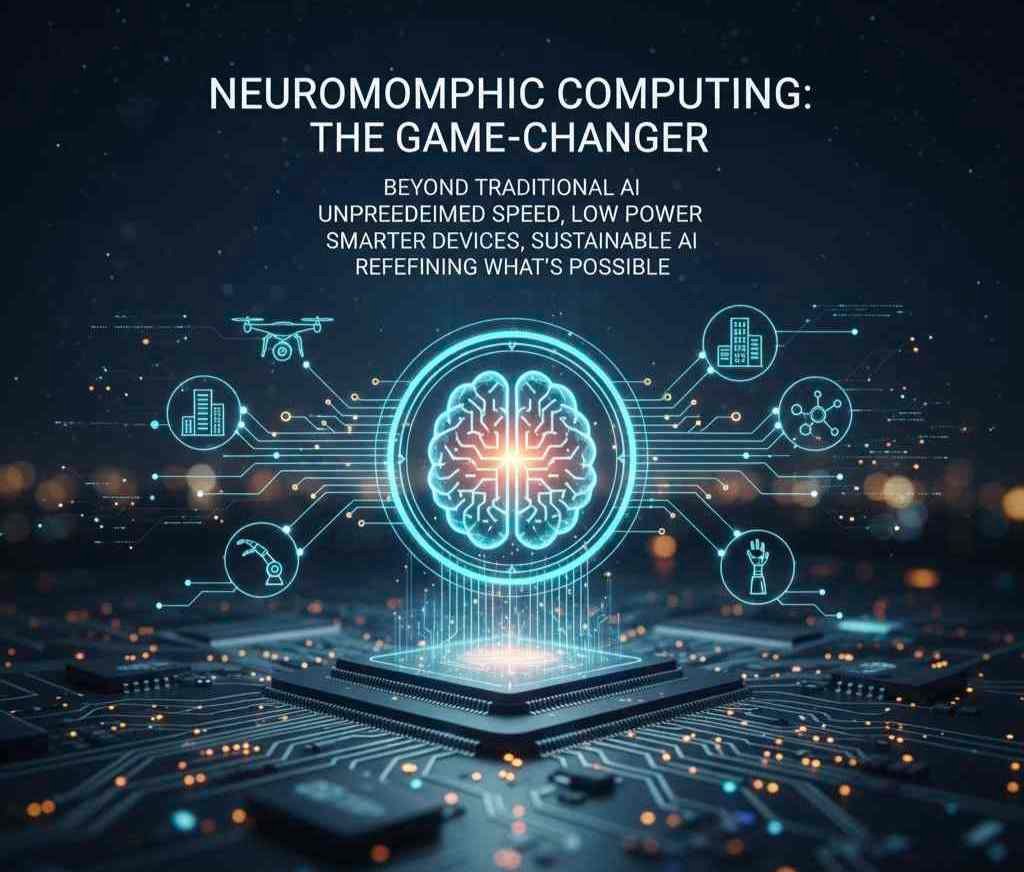
At its core, neuromorphic computing is an engineering approach that moves beyond traditional software to create computer chips modeled after the brain’s structure and information-processing methods. This “brain-inspired” architecture is fundamentally different from the conventional computers we use today, which are built on the Von Neumann architecture.
The Von Neumann Memory Bottleneck
This decades-old design has a critical flaw known as the memory bottleneck, where the processor and memory are separate units. This forces data to constantly travel back and forth on a digital “highway,” creating a traffic jam that slows computation and wastes immense energy.
Why Mimic the Brain?
So, why mimic the brain? The advantages are profound:
- Radical energy efficiency: the human brain operates on roughly 20 watts, while training large AI models can consume enough energy to power hundreds of homes.
- Low latency: by colocating processing and memory, neuromorphic systems can react to data in real-time, which is crucial for applications like autonomous vehicles.
- Massive parallelism: they can process vast streams of sensory data—sight, sound, etc.—simultaneously, just like our own neural networks do.
What This Blog Covers on Neuromorphic Computing
The Science Behind the Revolution: Core Concepts
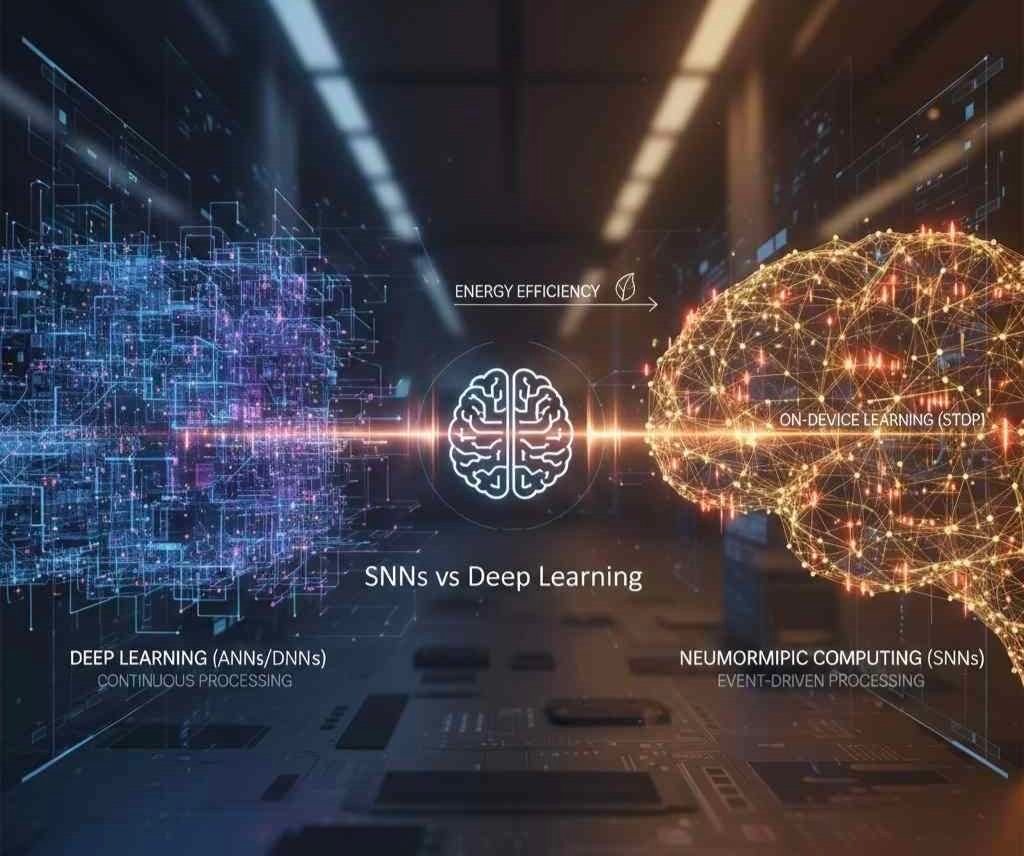
While traditional Deep Learning relies on dense, continuous calculations (using ANNs – Artificial Neural Networks / DNNs – Deep Neural Networks), Neuromorphic Computing mimics the brain’s efficient, event-driven operation. The key difference lies in Spiking Neural Networks (SNNs) vs Deep Learning. Instead of constantly processing data, SNNs communicate via discrete “spikes,” only activating when a threshold is reached. This is like your brain versus a constantly whirring computer fan.
This leads to two revolutionary principles. First, event-driven processing means the system is asynchronous and sparse; components power up only when they receive a signal, slashing energy use. Second, the hardware itself is built with artificial neurons and synapses made from novel materials, physically replicating the brain’s network to execute these spikes with incredible speed and efficiency.
“Neuromorphic Computing in 2 Minutes” by 2 Minute Expert (2MinExpert).
Finally, synaptic plasticity allows these systems to learn on-device. Through a rule called Spike-Timing-Dependent Plasticity (STDP), connections between artificial neurons strengthen or weaken based on the timing of spikes, enabling continuous, low-power learning from new data without constant human intervention.
Neuromorphic Hardware: The Major Players and Chips
The field of neuromorphic computing is driven by innovative hardware designed to mimic the brain’s efficiency. Leading this effort, Intel’s Loihi and Hala Point chips use a scalable architecture for real-time learning in applications like smart robotics and sensory processing. IBM’s True North was a pioneering design that proved ultra-low-power, event-based processing was feasible. In Europe, the SpiNNaker and BrainScaleS projects focus on massive scalability for large-scale neural network simulations.
Underpinning these systems, emerging memory technologies like memristors are crucial, acting as artificial synapses to enable faster and more energy-efficient on-chip learning.
How Neuromorphic Computing is Solving Real-World Problems
Neuromorphic computing is revolutionizing industries by mimicking the brain’s efficient, parallel processing. For Edge AI and IoT, it enables smart sensors and drones to process data in real-time with minimal power, operating independently of the cloud. In autonomous vehicles and robotics, it provides the adaptive control and sensor fusion needed for safe, intelligent navigation.
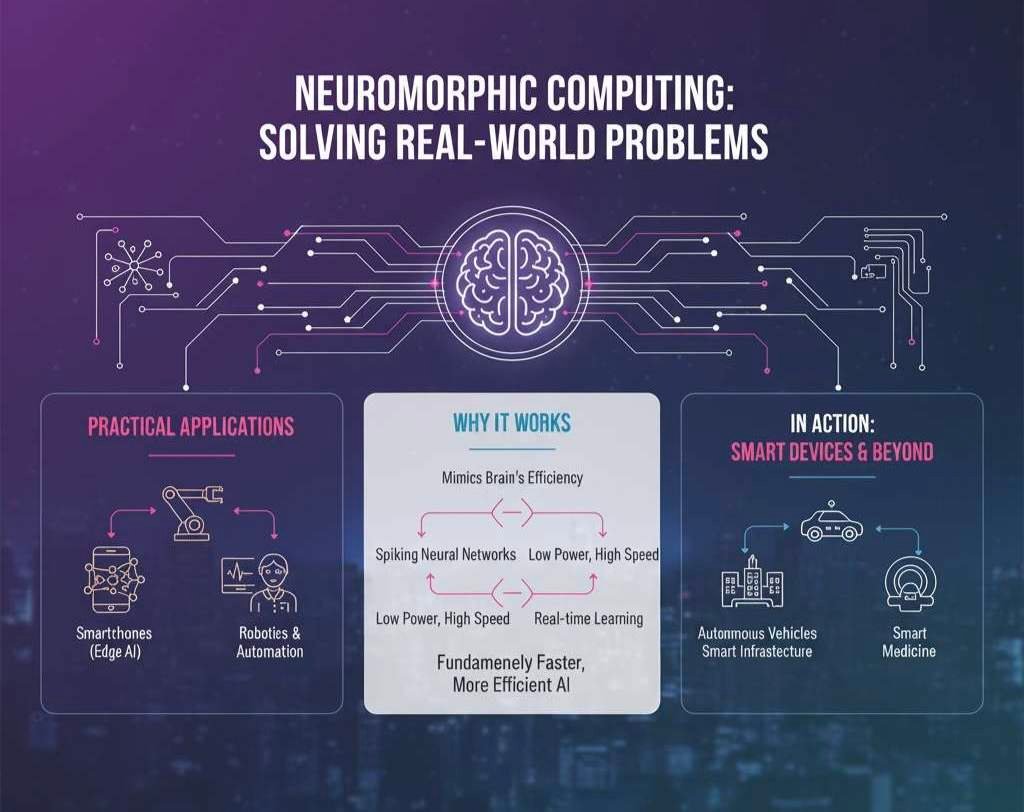
This technology excels at security and anomaly detection, identifying subtle threats in massive data streams that conventional computers miss. Furthermore, it accelerates computational neuroscience by creating highly accurate brain simulations, aiding critical research into neurological disorders and cognitive function.
Challenges in Neuromorphic Computing
Despite its promise, neuromorphic computing faces significant hurdles before mass adoption. A major challenge is Programming and Algorithm Development, as coding for Spiking Neural Networks (SNNs) requires a completely different approach compared to traditional software. Furthermore, Manufacturing and Scalability issues persist, with the specialized chips being difficult and costly to produce at scale outside research labs.
Integration with Existing Infrastructure is another barrier, as these systems are not plug-and-play replacements for current hardware. Finally, the lack of standardized Benchmarking and Performance Metrics makes it difficult to compare a neuromorphic chip’s efficiency directly against a conventional GPU, creating uncertainty for potential users.
The Future of Neuromorphic Computing
The Timeline: When Will it Go Mainstream?
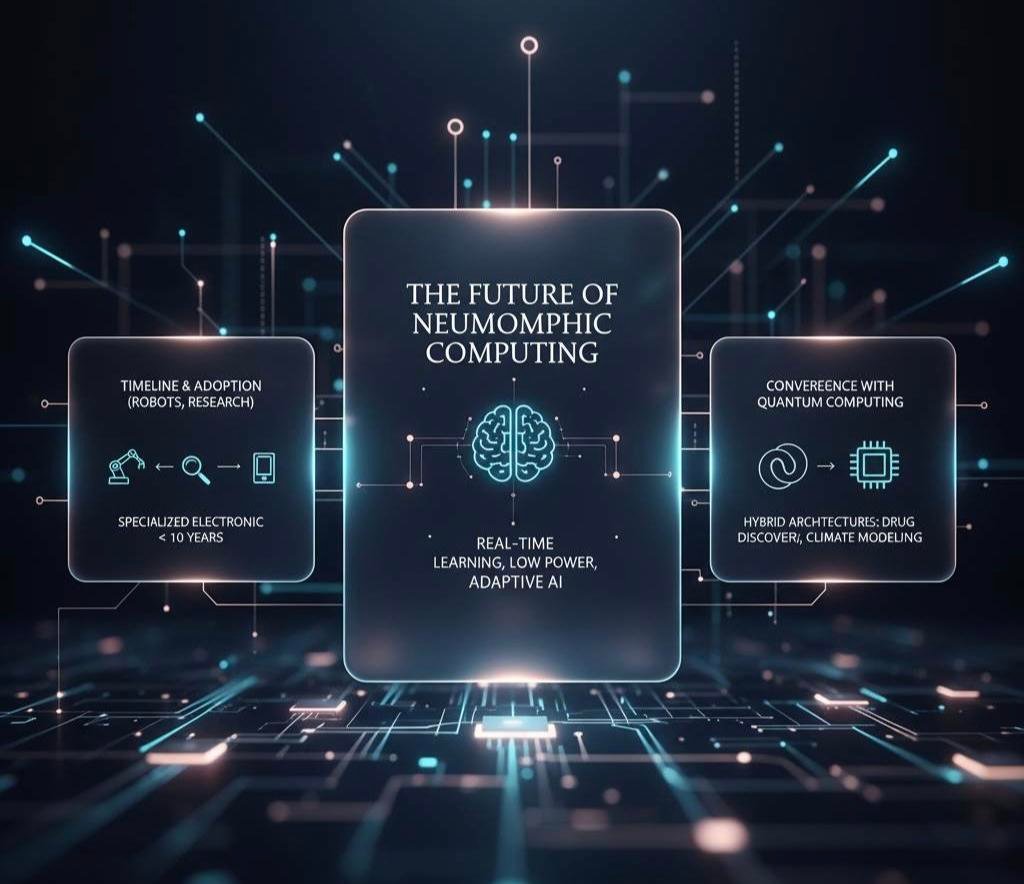
Widespread use is about a decade away. You’ll first see these brain-inspired chips in specialized areas like robotics and scientific research before they become common in consumer electronics.
Potential to Unlock Next-Generation AI
This technology promises to move beyond today’s large language models. It could enable real-time learning and decision-making with drastically lower power consumption, creating more adaptive and efficient artificial intelligence.
Convergence with Quantum Computing
The most exciting potential lies in synergy. Neuromorphic systems are poised to converge with quantum computing, creating hybrid architectures to solve complex problems in drug discovery and climate modeling that are currently unsolvable.
In conclusion, neuromorphic computing is a true game-changer, moving us beyond traditional AI. By mimicking the brain’s incredible efficiency, these chips offer unprecedented speed and drastically lower power consumption. This isn’t just an upgrade; it’s a fundamental shift enabling smarter, more autonomous devices and sustainable AI growth. The future of brain-inspired computing is here, promising to redefine what’s possible. What are your thoughts on the future of brain-inspired AI?
That’s all for this blog! If you have any thoughts, questions, or suggestions for topics you’d like me to cover, write them in the comments. I’ll personally make sure to explore them in future posts.
FAQ About Neuromorphic Computing
1. Introduction & Basics
What is neuromorphic computing?
Neuromorphic computing is a type of computer engineering that models its structure and operation on the human brain. It uses artificial neurons and synapses to process information in a highly efficient, low-power way.
What is meant by neuromorphic computing?
“Neuromorphic” means “brain-shaped.” It refers to creating computer chips that mimic the brain’s neural architecture to achieve intelligent, energy-efficient computation.
What is another name for neuromorphic computing?
It is often called brain-inspired computing or neuromorphic engineering.
2. Neuromorphic Computing vs. AI & Traditional Computing
What is the difference between AI and neuromorphic computing?
AI is the software—the algorithms and programs that enable intelligent behavior. Neuromorphic computing is the hardware—the physical chips designed to run AI algorithms much more efficiently, much like a brain.
Is neuromorphic computing the same as AI?
No. Think of AI as the mind and neuromorphic computing as the brain. They work together but are distinct concepts.
What is neuromorphic computing in AI?
In AI, neuromorphic computing provides a powerful, low-power hardware platform to run complex neural networks, significantly speeding up tasks like pattern recognition and sensory processing.
How is neuromorphic computing different from normal computing?
Normal computing uses a central processor (CPU) that executes tasks sequentially. Neuromorphic computing, like our brains, uses a massive network of artificial neurons that work in parallel, making it faster and more energy-efficient for specific tasks.
3. History & Pioneers
Who invented neuromorphic computing?
The term was coined by Carver Mead, a professor at Caltech, in the late 1980s.
Who is the father of neuromorphic computing?
Carver Mead is widely considered the father of this field for his pioneering work in applying brain principles to silicon chips.
What is Carver Mead’s role in Synaptics?
Carver Mead co-founded Synaptics, a company that applied his early neuromorphic principles to create the touchpad, a technology now used in millions of laptops.
4. Companies & Leaders
Who is the leader in neuromorphic computing?
While there’s no single leader, tech giants and research institutions are at the forefront. Intel with its Loihi chip and IBM with TrueNorth are key players, alongside research from the Human Brain Project.
What companies are working on neuromorphic computing?
Major companies include Intel, IBM, Samsung, and Qualcomm. Research labs like IMEC and Stanford University are also heavily involved.
5. Applications & Examples
What is an example of neuromorphic computing in real life?
A great example is a smartphone camera that can recognize faces or objects instantly while using very little battery, thanks to a neuromorphic chip.
What are the real-life applications of neuromorphic computing?
Applications include smarter robotics, advanced driver-assistance systems (ADAS), efficient voice assistants, and powerful sensors for the Internet of Things (IoT).
What is an example of a neuromorphic device?
Intel’s Loihi 2 chip is a prime example—a research chip that learns and adapts in real time from its environment.
What is a real-life example of a neural network?
The recommendation algorithm on Netflix or Spotify is a common example. It’s a software-based neural network that learns your preferences to suggest movies or music.
6. Future & Challenges
Is neuromorphic computing the future?
Yes, it’s a key part of the future for edge computing and AI, enabling intelligent devices to process data locally with extreme efficiency, much like a human brain.
What is the problem with neuromorphic computing?
The main challenges are designing new software specifically for this unique hardware and scaling up the technology affordably for widespread commercial use.
What is the world’s largest neuromorphic system?
Currently, one of the largest is DeepSouth, a supercomputer being built to simulate neural networks at a massive scale, with a raw neuron count rivaling the human brain’s.