Introduction
Imagine a record-keeping system so transparent and secure that no single person or company controls it, yet everyone can trust it. This is the revolutionary promise of blockchain, the foundational technology behind Bitcoin.
However, viewing blockchain only as “cryptocurrency’s engine” misses the bigger picture. This article cuts through the hype to provide a clear and grounded introduction to blockchain technology.
We move beyond abstract definitions to explore its architecture, how it functions step by step, and most importantly how its influence is expanding into real-life applications you interact with every day, from the food you eat to how you verify your digital identity.
As someone who has analyzed blockchain implementations across supply chains and digital contracts, its potential to rebuild trust in systems becomes evident. Let’s build your understanding from the ground up.
What Is a Blockchain System?
At its core, a blockchain is a specific type of database, but its design philosophy sets it apart. Rather than a single spreadsheet controlled by one authority, it functions more like a digital coral reef.
Each piece of coral (a block) is permanently cemented to the one before it, creating a growing and interconnected structure. This reef is not owned by a single entity; it is maintained by a distributed network of computers.
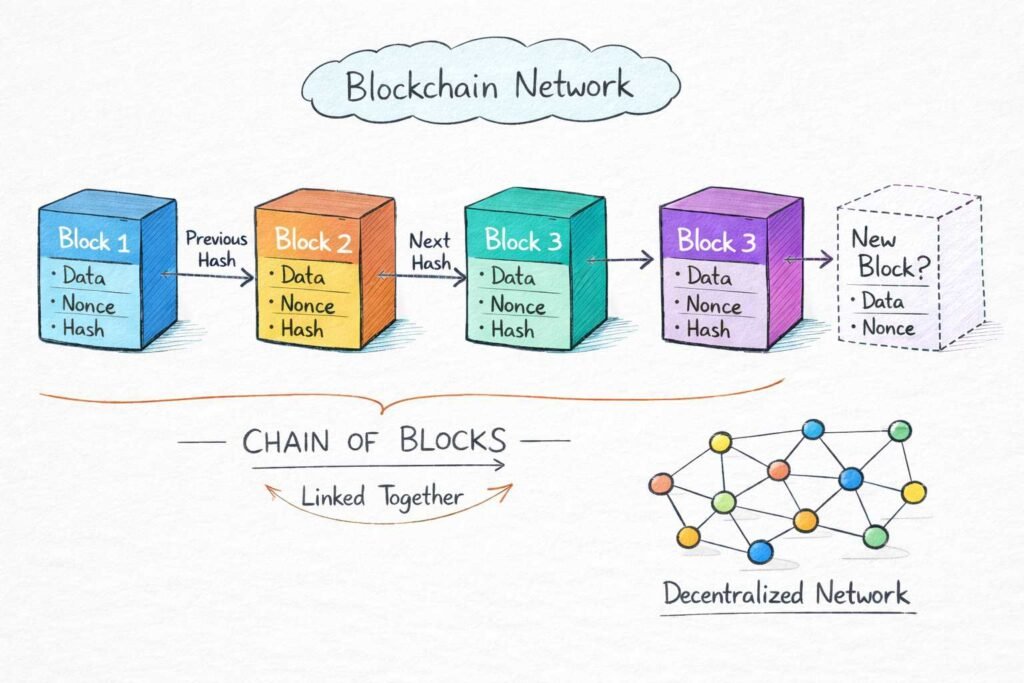
This design makes blockchain an immutable and decentralized ledger.
- Immutable:
Once data is added, it becomes practically impossible to alter or delete,
creating a permanent and verifiable history. - Decentralized:
No central authority controls the system. Instead, network participants
collectively manage and verify the ledger.
The Structure of Blockchain: Core Components
To understand the system, it is essential to know its core components.
1. Blocks
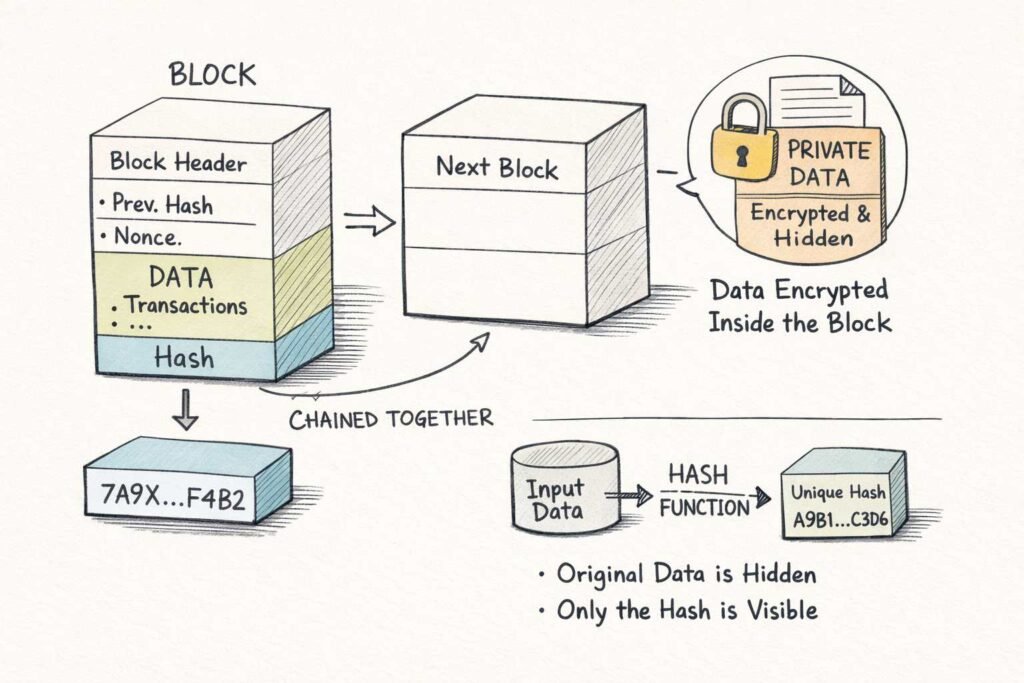
Blocks are containers for data. Each block stores three key elements:
- A bundle of transactions or information
- Its own unique digital fingerprint, known as a hash
- The hash of the previous block
2. The Chain
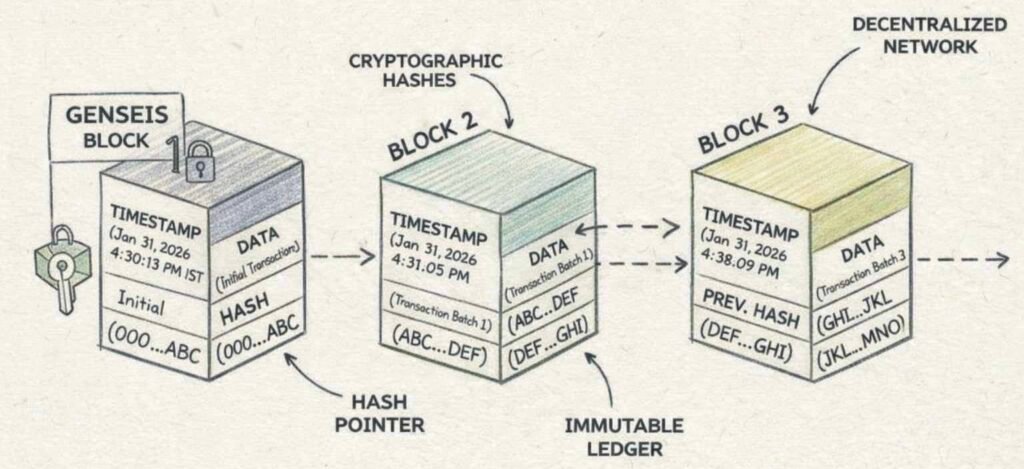
The chain is the critical linking mechanism. By including the previous block’s hash, each block is cryptographically connected to the one before it.
If data in any earlier block were altered, its hash would change, breaking the chain and immediately alerting the entire network to the inconsistency.
3. The Network (Nodes)
A blockchain operates on a peer-to-peer network of computers known as nodes. Each node stores a complete copy of the entire ledger and continuously verifies new blocks against the existing history.
This constant verification by multiple independent participants is what enables true decentralization and system-wide trust.
How Blockchain Systems Actually Work: A Simple Breakdown
Let’s trace a simple transaction, such as sending a digital asset.
1. A Request Is Made
You initiate a transaction, for example: “Send X to Person B.”
2. Broadcast to the Network
The transaction request is broadcast to a global network of computers, known as nodes.
3. Validation
The nodes validate the transaction using a consensus mechanism such as Proof of Work or Proof of Stake. These are predefined rules that all nodes agree upon to ensure the transaction is legitimate.
4. Block Formation
Once validated, the transaction is grouped together with other verified transactions and added to a new block.
5. Chaining
The new block is cryptographically sealed and linked to the most recent block in the existing blockchain.
6. The Update
The updated version of the blockchain is distributed across all nodes in the network. The transaction now becomes an immutable part of the shared ledger.
Why Are Blockchain Systems Used? The Trust Equation
The core value proposition of blockchain technology is trustless trust. In traditional systems, we rely on intermediaries such as banks, governments, or large platforms to act as trusted record-keepers.
Blockchain replaces these intermediaries with cryptographic proof and network consensus, allowing participants to trust the system itself rather than a central authority.
This enables:
- Transparency:
All participants have access to the same verified and shared history of data. - Security:
The decentralized and immutable nature of the ledger makes it highly resistant to fraud and cyberattacks. - Traceability:
Every record leaves a permanent, auditable trail that can be traced back
to its origin.
Blockchain in Real Life: Applications Beyond Cryptocurrency
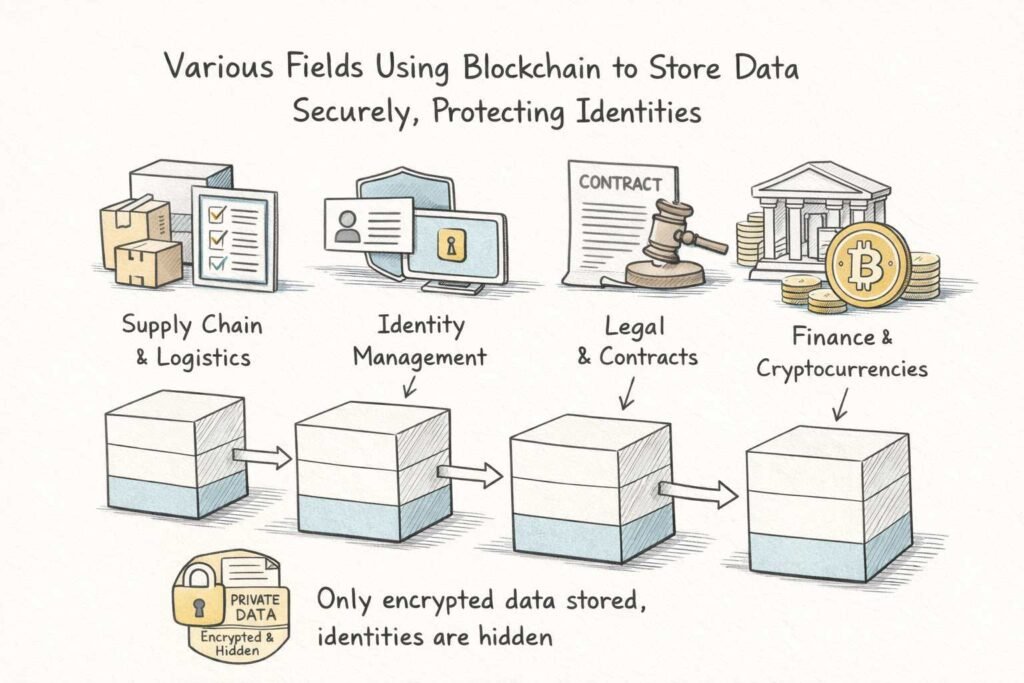
While digital currencies like Bitcoin are the most well-known application, the true test of any technology lies in its broader real-world impact. Blockchain technology is already being applied in several meaningful ways.
Supply Chain Provenance
Blockchain is transforming supply chain transparency. Initiatives such as IBM Food Trust use blockchain to track food from farm to shelf.
Each transfer, inspection, or certification becomes a block on the chain. This allows consumers to scan a QR code and view a product’s entire journey, helping ensure freshness, safety, and ethical sourcing.
Digital Identity
Blockchain enables the concept of self-sovereign digital identity. Instead of storing personal data in centralized databases, individuals can control access to their verified credentials, such as age, education, or professional qualifications.
Only the required information is shared, without exposing original documents, significantly reducing the risk of identity theft. Organizations such as the World Bank have explored these systems to empower refugees and unbanked populations.
Smart Contracts
Smart contracts are self-executing agreements where the contract terms are written directly into code and stored on the blockchain.
For example, an insurance payout could be triggered automatically when a verified weather station reports flooding in a specific region, eliminating manual claims processing and reducing delays.
A Note to Our Readers
This article serves as a foundational guide for general understanding. If you have specific questions or unique perspectives on blockchain systems and their growing influence in sectors such as healthcare, voting, or real estate, we invite you to share them in the comments.
Our next article will explore a more advanced topic within the blockchain ecosystem.
Important Disclaimer
While blockchain offers enhanced security and transparency, it is not without risk. The technology is still evolving, and some implementations may contain vulnerabilities.
Additionally, cryptocurrency markets are highly volatile. Always conduct thorough, independent research and exercise caution before participating in any blockchain-based financial system.
Conclusion and Key Takeaways
Blockchain is more than a buzzword. It represents a fundamental shift in how information is recorded, verified, and trusted in a digital world.
- It Is a Decentralized Ledger:
A shared, immutable record maintained by a network rather than a central authority. - Security Through Structure:
Chained blocks and consensus mechanisms make the system transparent and
highly resistant to tampering. - It Enables Trustless Interaction:
Parties can transact directly using cryptographic proof, reducing reliance
on intermediaries. - Its Reach Is Expanding:
From ethical supply chains to portable digital identities, blockchain
is solving real-world problems.
The journey into blockchain technology is only beginning. Your next step is to recognize its touchpoints in everyday life perhaps through a product’s tracking feature or a discussion around digital voting.
When you notice it, you will now understand the powerful structure working quietly beneath the surface.