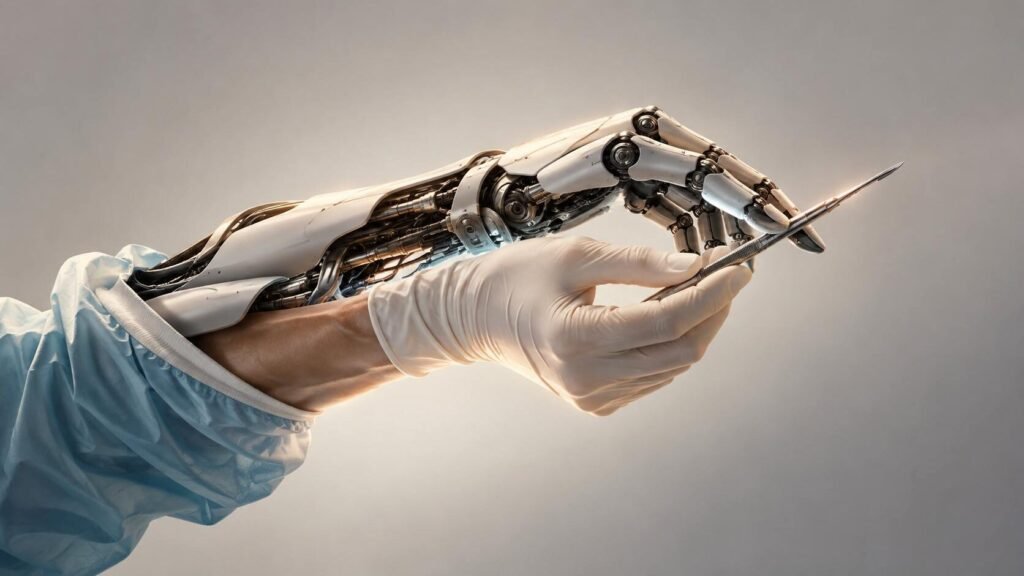
For decades, medicine relied purely on a doctor’s eyes, hands, and memorized textbooks: slow, careful, but limited by human bandwidth. Today, AI in the medical field is changing that baseline. Where an old-school diagnosis meant flipping through patient history by hand, modern hospitals now use technology that scans thousands of records in seconds. Where treatment once depended on one specialist’s experience, AI tools now cross-check millions of similar cases instantly.
This is not a replacement of medicine’s core; it is a shift in speed and scale. This post explores where old methods still hold strong, and where new AI-driven technology has already taken over.
AI in the Medical Field: What Can Be Replaced, and What Can’t
As the previous section showed, AI in the medical field has already changed the pace of healthcare, but speed alone doesn’t make it a replacement for human expertise. AI and doctors are not two versions of the same tool; they are built for fundamentally different kinds of work. Understanding where each one genuinely excels, and where each one fails, explains why the “AI versus doctors” debate misses the real picture entirely.
AI consistently wins at structured, repetitive, data-heavy tasks. Reading thousands of X-rays for a specific pattern, flagging abnormal lab values, cross-checking drug interactions, or tracking vitals from a wearable device are jobs built on consistent rules and large datasets exactly what machine learning is designed to process.
A radiology AI model doesn’t get tired after the two-hundredth scan of the day, and it applies the same detection threshold to every single image. This is why diagnostic imaging, pathology slide screening, and administrative documentation have become the fastest-growing areas of AI adoption in hospitals worldwide.
Humans remain irreplaceable wherever judgment, responsibility, and emotional context matter more than pattern recognition. A diagnosis is not just a data point; it’s a conversation that requires reading body language, weighing a patient’s personal history, and deciding how much information someone is ready to hear in that moment. Legal and ethical accountability also sits entirely with a licensed clinician; no algorithm can be held responsible for a treatment outcome. Hands-on care, physical examinations, comforting a frightened family, and navigating ambiguous symptoms that don’t fit a textbook pattern all require the kind of contextual reasoning AI simply cannot replicate.
Between these two extremes sits a growing middle ground, where AI and humans work as a team rather than as competitors. Rare disease diagnosis is a strong example: a single doctor may see a specific rare condition once in an entire career, but an AI model trained on millions of case records can flag the same pattern in seconds, giving the doctor a lead they might never have found alone.
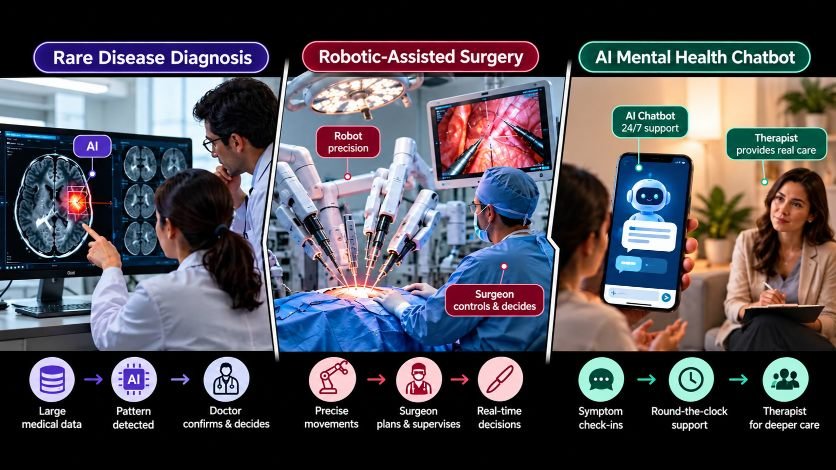
Robotic-assisted surgery follows the same logic: the robot provides mechanical precision, but the surgeon still plans the procedure, supervises every movement, and makes real-time decisions mid-operation. Even AI-powered mental health chat bots fit this pattern: useful for round-the-clock symptom check-ins, but incapable of replacing the depth of a real therapeutic relationship.
This is the real divide in modern medicine: AI replaces tasks, not professions. Clinical work built on volume, speed, and pattern-matching is shifting toward automation fast. Clinical work built on judgment, responsibility, and human connection isn’t going anywhere. The next sections in this series will dig deeper into specific fields, starting with where this line is already being tested the hardest: radiology and surgery.
The Core Difference: How AI Works vs. How Humans Work
AI in the medical field runs on pattern recognition. It studies huge datasets, finds statistical correlations, and applies them to new cases, essentially matching what it sees to what it has already learned. It has no understanding, only calculation; a tumor “looks like” cancer because pixels match a trained pattern, not because the system comprehends disease.
Human doctors work through reasoning. They combine training, lived experience, intuition, and real-time context like a patient’s tone of voice or unspoken fear to make a judgment call that goes beyond data alone. A doctor can adapt mid-decision when something doesn’t fit the textbook; AI cannot improvise outside its training.
In short: AI recognizes patterns at scale. Humans understand meaning and carry responsibility for the outcome. That distinction defines every limitation and advantage in this debate.
Conclusion: Where AI in the Medical Field Goes From Here
AI in the medical field isn’t a question of one replacing the other; it’s a question of where each one belongs. The technology processes data, spots patterns, and saves time; the human provides judgment, responsibility, and trust things no algorithm can replicate. That balance is already reshaping how hospitals run.
Upcoming posts will break this topic down by field: surgery, medicine, and radiology each face AI very differently. Have a question, or see this differently? Drop it in the comments below; your perspective adds to this conversation.
Follow me on Instagram for more insights on AI in healthcare, medical technology, and the future of medicine.